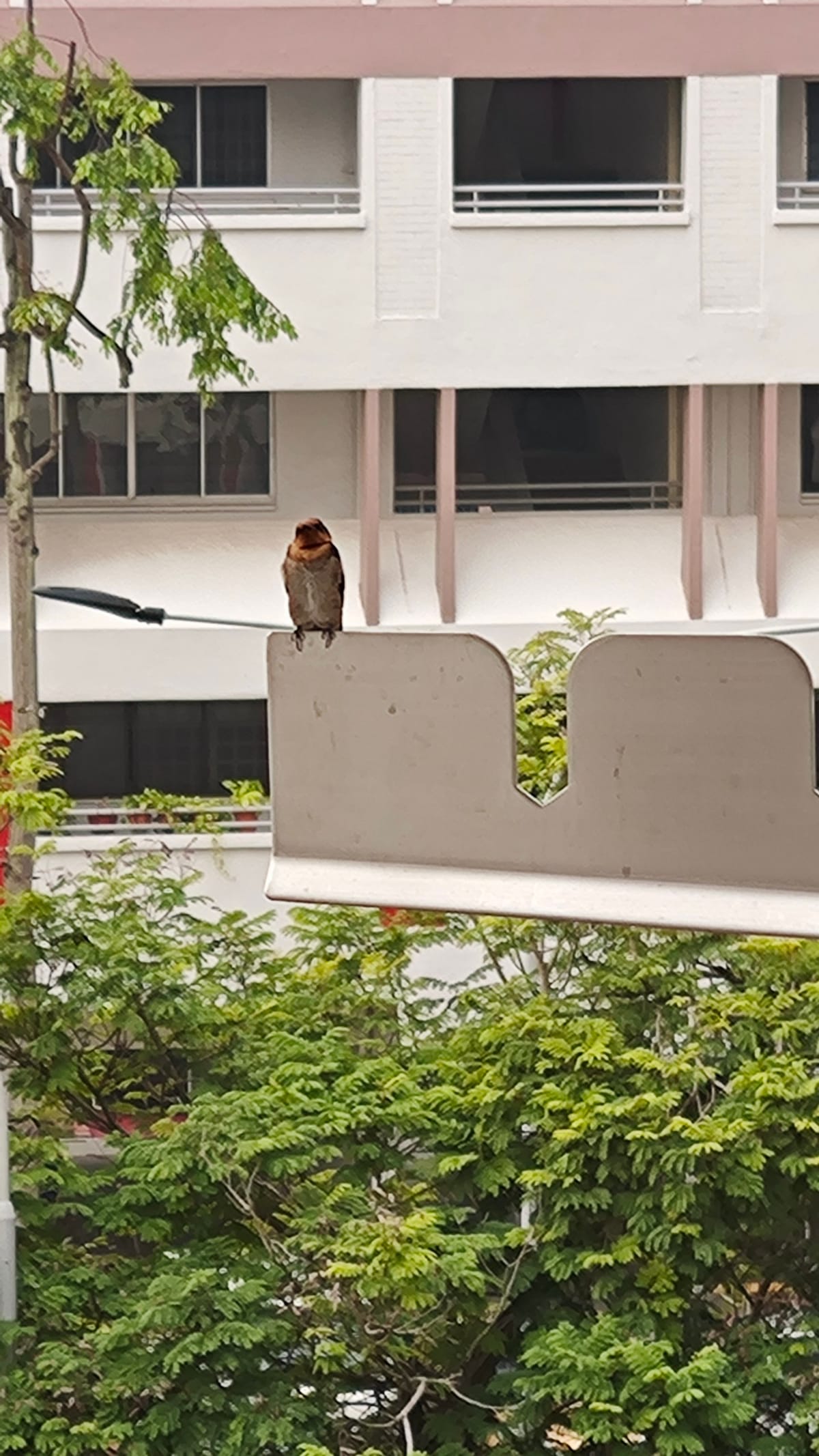
Spotted in the wild: a Pacific Swallow perched on the edge of a metal panel outside a residential block, sitting still and close enough to photograph properly — which is not how I usually see this bird. Normally it's a dark shape crossing the void deck at speed, gone before you can focus.
This is the Pacific Swallow (Hirundo javanica), a small passerine in the swallow family, Hirundinidae, and a bird of about 13–14 cm. It breeds across tropical southern Asia and the islands of the south Pacific and is resident rather than migratory, with only some local seasonal movement. Singapore Birds lists it as a very common resident, found extensively throughout the island; the Malay name is Layang-layang Biasa, and the Chinese is 洋燕. The subspecies that occurs locally is javanica, which ranges from southern Myanmar and the Andaman Islands east to the Philippines and south through the Sunda Islands.
How I'm identifying it
Pacific Swallow, rather than the Barn Swallow everyone knows from the northern hemisphere. The plumage in this photo is the giveaway: a rich rufous-brown face, throat and upper breast, glossy blue-black upperparts with browner wings and tail, and greyish rather than white underparts. A Barn Swallow has the chestnut confined to the throat under a dark blue-black crown and face — here the whole head is red-brown. The other name on the local confusion list is the Eastern Red-rumped Swallow.
The Pacific Swallow also has a shorter and less forked tail than the Barn Swallow, which is the standard field mark — I'll admit the front-on angle here doesn't let me judge that properly, so this identification rests on the colour of the head, throat and underparts. If anyone with more birding hours than me wants to argue the tail, I'll take the correction.
Why it's here at all
Swallows are aerial insectivores, and the Pacific Swallow takes its insects on the wing, folding its wings back in flight in a way that distinguishes it from other airborne birds. It is also, quietly, an urban specialist. The nest is a neat cup built from mud pellets collected in the beak — a beakful of wet mud at a time — stuck under a cliff ledge or, far more often in a city, on a man-made structure: a building, a bridge, a tunnel. The clutch is two to three eggs.
That is the part I find interesting. The architecture is the habitat. A bird that nests on overhangs and hunts open air has found in the housing estate almost exactly the cliff face and the airspace it would have used anyway.
The perch
The perch itself is a white powder-coated metal panel with two large rounded cut-outs along its top edge, part of some outdoor fixture along a pedestrian route. The bird had claimed the highest point of it and was facing straight down the lens, feet gripping the lip, head slightly cocked. It did not seem to be resting so much as waiting to launch — which is what swallows do between hunting runs.
One taxonomic note, since the field guides are still catching up: the Pacific Swallow was until recently treated as the same species as the Tahiti Swallow and carried the binomial Hirundo tahitica. The two were split on morphological differences, and the name now in use for this bird is Hirundo javanica, described by Sparrman in 1789 from a specimen collected on Java. Six subspecies are recognised across the range; javanica is the one on this panel.
No grand claims from me — this is a sighting, not a review. I'll keep an eye on the same ledge over the next few weeks; if a mud cup appears under it, that will be a better post than this one. 🐦

Member discussion: